


Pediatric Mechanical Circulatory Devices
By David Whiting, MD, FAAP Instructor in Anaesthesia
Yuki Koichi, MD, Assistant Professor of Anesthesia
Division of Cardiac Anesthesia, Department of Anesthesiology,
Perioperative and Pain Medicine, Boston Children's Hospital
Department of Anaesthesia, Harvard Medical School
Boston, MA
The role of mechanical circulatory support in children with circulatory failure is expanding. It is estimated that 46% of children with heart failure die or undergo transplantation within five years.1 Children with refractory heart failure have fewer options for mechanical circulatory support (MCS) than adults. Ventricular assist devices (VAD) have been used in adults for short-term support in patients with right and left ventricular dysfunction, and for long-term support as a bridge to transplantation. The development of pediatric VADs has lagged in part because of the wide range in size of pediatric patients and biological differences in anticoagulation therapy in children.2 Adult MCS devices have been used in intermediate sized children, but with cannulation difficulties and persistent thromboembolic problems.
Until recently, MCS in pediatric patients has been limited to short term extra corporeal membrane oxygenation (ECMO) therapy. However, neurological injuries and problems associated with systemic anticoagulation have precluded its use for long term therapy. A recent national analysis of ECMO as a bridge to transplantation in children indicated that fewer than half survive to hospital discharge.3 Recognizing these limitations, the National Heart Lung and Blood Institute has supported the preclinical development of MCSs for infants and small children. These devices will be available through the Pumps for Kids, Infants, and Neonates (PUMPKIN) program. In addition, there has been an effort made to improve and standardize the clinical management of currently available VADs.
ECMO
ECMO is the most commonly used MCS in children. ECMO can be instituted rapidly as an adjunct to cardiopulmonary resuscitation (CPR) and provides full cardiorespiratory support, while VADs provide only cardiac support. ECMO may be superior to VADs for children with heart failure secondary to pulmonary hypertension, complex congenital heart disease with intra-cardiac shunts, and patients with respiratory failure and severe hypoxemia. The patient must remain intubated and sedated, and typically can be maintained for only one to three weeks before neurologic and other organ dysfunction develop.4 ECMO requires anticoagulation with unfractionated heparin, full time monitoring by highly trained personnel, and frequent transfusions and circuit changes. ECMO patients must remain in the intensive care unit and are immobile - a significant disadvantage when compared to long term VAD options.
ECMO circuits can be used for venovenous (VV) or venoarterial (VA) support. VV ECMO is used for severe pulmonary dysfunction with preserved myocardial function, while VA ECMO is used for cardio-respiratory failure. In VA ECMO, the circuit is comprised of an arterial cannula that is placed in the carotid or femoral artery and a venous cannula placed in the internal jugular or femoral vein. A heat exchanger in the circuit allows for temperature control. An ECMO circuit is able to provide at least 100-150 mL/kg/min of oxygenated, nonpulsatile blood flow, with pressure generated by a centrifugal or nonocclusive roller pump. VA ECMO is managed in a similar way to cardiopulmonary bypass (CPB), though venous drainage is frequently restricted to allow for systemic ventricular ejection, as in partial CPB.
Pulsatile Ventricular Assist Devices
Ventricular assist devices are indicated for isolated ventricular dysfunction. Blood flow may be pulsatile or nonpulsatile. Pulsatile blood flow is created by prosthetic ventricles that are driven by pulsatile pneumatic or electromechanical pumps. The major difficulty in translating this technology to the pediatric population has been the size constraints of the inflow and outflow cannula as well as the large stroke volumes delivered by these devices. Blood is drawn into these devices by negative pressure and ejected into the circulation by vacuum or mechanical pressure applied to the membrane device. Unlike ECMO support, these devices do not require anticoagulation with unfractionated heparin. Protocols vary, but less aggressive anticoagulation with anti-platelet agents, warfarin, or low molecular weight heparin are frequently employed.
The FDA approval of the Berlin Heart EXCOR® Pediatric VAD in 2011 under a Humanitarian Device Exception (HDE) expands bridge to transplant therapy to pediatric patients from newborns as small as 3 kg to teenagers. The Berlin Heart EXCOR® VAD is a paracorporeal, pneumatically driven, pulsatile-flow MCS with stroke volumes of 10, 25, 30, 50, 60 and 80 mL (60 and 80 mL available only in Europe). (Figure 1) The device is implanted in series with the native circulation; the inflow cannula is placed in the apex of the ventricle and the outflow cannula is placed in the great vessel. Devices placed in series generally provide better device output than parallel devices (inflow cannula placed in the atrium) because the device does not compete with the native ventricle for atrial blood. (Figure 2) VADs in series provide a low-impedance outflow tract for the native ventricle, thus filling the device during systole and decreasing native ventricular diameter and wall stress. LV decompression is more complete and there may be a lower risk of thrombosis and cerebral infarcts.5,6 However, devices in series may result in dyskinetic or a kinetic apical ventricular function, which may affect myocardial function after removal.


Prosthetic ventricle VADs, like the Berlin Heart function with a fixed rate and variable stroke volume. This volume or "fill to empty" mode triggers ejection only when the prosthetic ventricle is filled with blood during diastole. Device output is directly related to ventricular and device filling. The VAD is dependent on preload and when placed in the left sided circulation, on right ventricular output. Right ventricular output is often compromised by decompression of the left ventricle and subsequent loss of left ventricular assist in right heart emptying, as well as potentially worsened tricuspid regurgitation. Efforts should be made to support the right ventricle by ensuring adequate preload, reducing pulmonary vascular resistance and possibly inotropic support of the right ventricle. Device output is also sensitive to afterload, sometimes requiring afterload reduction to maintain output.
A recent multicenter, single-group prospective trial of the EXCOR® Pediatric VAD in patients 16 years of age or younger revealed higher rates of survival when compared to ECMO in bridge to transplantation therapy. Patients were grouped into two cohorts (body-surface-area (BSA) <0.7 m2 and BSA 0.7 m2-<1.5 m2). Median survival was greater than 174 days vs. 13 days in the ECMO group, and 144 days vs. 10 days respectively.3 The prospective study noted a significant incidence of complications with the EXCOR® device (neurological deficits and infections) which were in line with the experience with adult VADs.
Nonpulsatile Ventricular Assist Devices
Nonpulsatile VADs generate blood flow with centrifugal or axial pumps. Centrifugal pumps are typically extracorporeal pumps placed in parallel with the native ventricle. The Bio-Medicus pump is an example of an extracorporeal centrifugal device capable of providing outputs of 2-6 L/min by creating a constrained vortex that draws blood into the device and imparts pressure to the blood as it leaves the device. These devices are exquisitely sensitive to preload and afterload. Pump output is determined by revolutions per minute (rpm) and ΔP (aortic pressure- LV pressure). Thus output is proportional to pump rpm (limited by inflow occlusion at the ventricle caused by negative pressure), and inversely proportional to ΔP.
The HeartWare® HVAD is an intracorporeal centrifugal VAD with limited FDA approval as an HDE in children. (Figure 3) The device is implanted in series to the native circulation, and is able to deliver blood flows of 1 to 10 L/min.7 The centrifugal impeller is the only moving part in the pump and spins at 2400-3200 RPM. Preliminary studies on pediatric patients were done with seven children aged six-sixteen years-old. Six patients of these had dilated cardiomyopathy and one was a Fontan patient with ventricular failure.8 These patients were maintained on the Heartware® device; six were successfully bridged to transplantation.

Axial pumps are intracorporeal pumps used in series with blood pressure generated by an impeller. The impeller rotates at high RPMs and imparts radial velocity to the blood as it is drawn into the device. The kinetic, rotational energy is converted to axial velocity and static pressure by stationary impeller blades as the blood leaves the device. Output from these devices is determined by rotational velocity (rpm) and dP (aortic pressure-LV pressure). Axial pumps are fully implantable.
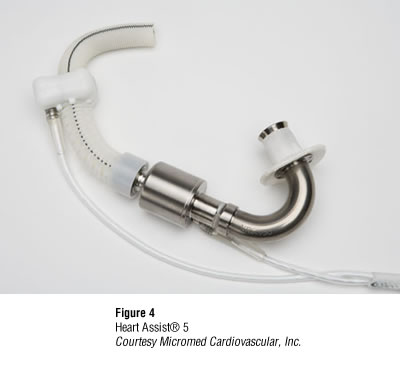
The Heart Assist® 5 (figure 4) VAD is a fully implantable axial pump that is implanted in series (left ventricle to aorta) to native circulation. It has been granted FDA approval as an HDE for use in pediatric patients as small as 18 kg. or 0.7-1.5m2, providing blood flow from 1-10 L/min. The pump is implanted in the pericardial space and is connected to a control unit and external battery pack percutaneously. Experience with this device is limited but encouraging.9
The role of MCS is expanding in pediatric patients as technology and experience improves. Shortage of donor organs especially in the pediatric population increases the waiting time for transplantation, and thus the number of children with refractory heart failure. Until recently, VAD therapy was not available for newborns and infants, and adult VADs used on larger children had unacceptable complication rates. The introduction of VADs designed for the pediatric population expands the available therapy for pediatric heart failure, and will likely be used in greater numbers as a bridge to transplantation. These VADs allow for management of refractory pediatric heart failure in an awake, mobile patient. Clinical trials are underway to determine best devices and management strategies in pediatric patients.
References
- Lloyd-Jones D, Adams RJ, Brown TM, et al. Heart Disease and stroke statistics-2010 update: a report from the American Heart Association: Circulation 2010; 121(7):e46e-215 [Erratum, Circulation 2011; 124(16);e425.]
- Fraser CD, Jr., Jaquiss RDB, Rosenthal DN, et al. Prospective trial of Pediatric Ventricular Assist Device. N Engl J Med 2012; 367: 532-41.
- Almond C, Singh TP, Gauvreau K, et al. Extracorporeal Membrane Oxygenation for Bridge to Transplantation Among Children in the United States: Analysis of Data from the Organ Procurement and Transplant Network and Extracorporeal Life Support Organization Registry. Circulation 2011; 123: 2975-2984.
- Aharon AS, Drinkwater DC, Jr., Churchwell KB, et al. Extracorporeal membrane oxygenation in children after repair of congenital cardiac lesions. Ann Thorac Surg 2001 Dec; 72(6): 2095-101; discussion 101-2.
- Acker MA. Mechanical circulatory support for patients with acute-fulminant myocarditis. Ann Thorac Surg 2001 Mar; 71 (3 Suppl.) S73--S76 [discussion S82-5]
- Joharchi MS, Neiser U, Lenschow U et al. Thoratec left ventricular assist device for bridging to recovery in fulminant myocarditis. Ann Thorac Surg 2002 Jul; 74(1): 234-235.
- LaRose JA, Tamez D, Ashenuga M, and C Reyes. Design Concepts and Principle of the HeartWare® Ventricular Assist System. ASAIO 2010; 56:285-289
- Miera O, Potapov EV, Redlin M, et al. First Experiences with the HeartWare® Ventricular Assist System in Children. Ann Thorac Surg 2011;91:1256-60.
- Fraser CD, Jr., Carberry KE, Owens WR, et al. Preliminary experience with the MicroMed® DeBakey pediatric ventricular assist device. Semin Thorac Cardiovasc Surg Pediatr Card Surg Annu 2006: 109-114.
